


PS5 DualSense stick drift, how to fix it (or get us to)
Why DualSense sticks drift, bounded DIY checks and the Hark Tech mail-in service: £27 for one stick or £35 for both, with tracked UK return, a 12-month warranty and 5–7 working days from arrival.
If the camera drifts when you're not touching it, your character walks slowly sideways on its own, or the menus scroll without input, your DualSense has stick drift. It's one of the most-complained-about faults in modern consoles, and Sony have been taken to court over it more than once. The good news: it's fixable, and the fix is usually cheap.
Why DualSense sticks drift
Under each analogue stick is a small plastic module with two potentiometers, one for each axis. Each potentiometer is a rotating wiper dragging across a resistive track, and that track wears with use. After a few hundred hours of gaming the track thins out at the "rest" position (the centre), the wiper starts reading voltages that don't correspond to an actual stick position, and the console thinks you're holding the stick slightly forward when you aren't. That's drift.
Dust and skin oil make it worse, but the root cause is mechanical wear. Cleaning cannot repair a physically worn carbon track, although it can reduce contamination-related symptoms temporarily.
1. Reset and recalibrate the controller
Before assuming a hardware fault, rule out a calibration glitch:
- On the PS5, go to Settings → Accessories → Controllers → Adjust Analog Stick Dead Zone and bump the dead zone up a notch or two. This masks small drift values and is fine as a long-term fix if the drift is barely perceptible.
- If the controller is misbehaving across multiple games or in menus, try the small reset pinhole on the back of the DualSense (next to the Sony logo), push a paperclip in and hold for 5 seconds, then re-pair it.
If the drift comes straight back, you have physical wear and you've moved on to the next levels.
2. Contact cleaner, a temporary fix only
A blast of IPA or isopropyl-based electrical contact cleaner into the base of the stick, followed by working the stick through its full range a few dozen times, can buy you a few weeks. Tilt the controller so the liquid runs out before powering it back on.
This is a delay tactic, not a fix. You'll be back here in a month.
3. Replace the stick module
The only cure for a worn analogue stick is a new analogue stick. The module is a standard part that can be desoldered and replaced, 14 or so solder joints per stick, plus a couple of mechanical tabs. It's fiddly but well within the capabilities of someone comfortable with a soldering iron and patient with small parts.
If you're not, we post you do the work.
What we do
We carry out DualSense stick replacement as a standard mail-in service.
Hark Tech repairs one DualSense stick for £27 or both for £35, including tracked UK return and a 12-month warranty; allow 5–7 working days from arrival. A free photo check confirms the suitable route before booking.
Post the controller (padded envelope is fine, protect the sticks with a bit of bubble wrap), and we'll diagnose it, confirm the price, replace the stick(s) and return it tracked.
Should I go Hall-effect or TMR instead?
Short answer: probably not, unless you specifically want to.
Hall Effect and TMR sticks sense position magnetically, removing the common carbon-track wear mechanism. Other mechanical, contamination and calibration faults can still occur, and compatibility must be confirmed for the controller.
For most players, a standard replacement costs a third as much, feels identical to the day the controller was new, and lasts another few hundred hours. If you've already replaced one standard stick and it's drifted again, that's when Hall-effect / TMR starts to make sense.
Longer write-up here: Hall Effect vs TMR vs standard sticks, the arguments are the same whether it's a Joy-Con or a DualSense.
Worth fixing or worth replacing?
Hark Tech's fixed one-stick repair is £27 including tracked UK return. If both sticks are worn and the shell is battered, compare the £35 two-stick repair with a current replacement price before deciding.
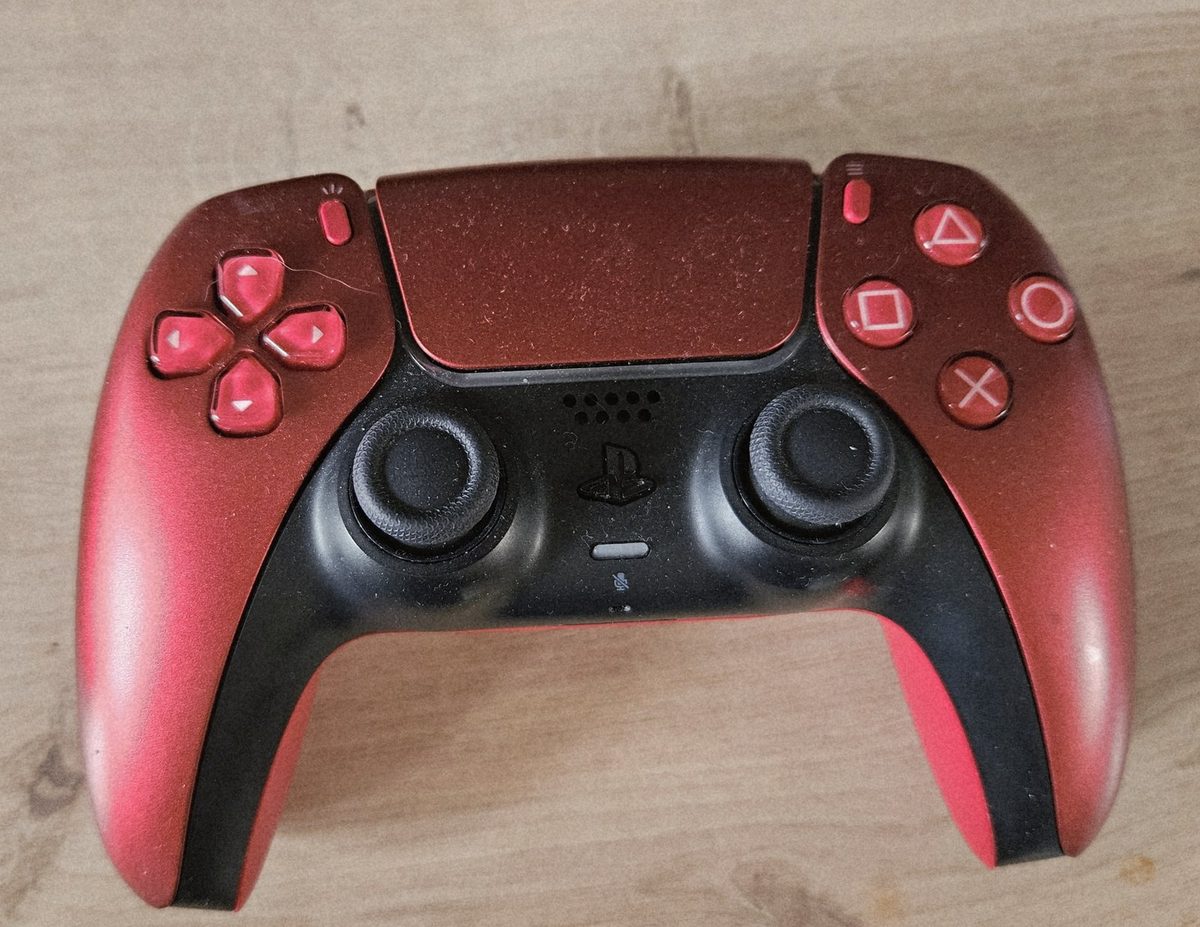
If it's a special edition you actually like, the Volcanic Red, the Cobalt Blue, a 30th Anniversary, always worth fixing. You can't just buy another one for £60 when they're discontinued.
Get it sorted
Allow 5–7 working days at the workshop from arrival to return dispatch; postage transit is additional. See the DualSense service page or request a free photo check via contact.