


BWT WS355 water softener board completely dead: one bad solder joint on the 3.3 V supply
At a glance
- Device: BWT WS355 water softener control board (marked SOFT2023 V1.0), posted on its own
- Fault: completely dead, with no display and no operation, even though the plug-in 12 V power supply tested fine
- Cause: one bad solder joint on a small capacitor on the 3.3 V supply next to the processor, most likely affected by humidity
- Fix: remade the joint. No new parts were needed.
- Time: fixed on the day it arrived
- Result: the board starts up and the display works on the bench, flashing 0:00 because the clock has reset
- Cost to the owner: £35 in total (£15 deposit, then £20 on completion), including tracked return postage
The fault
The owner got in touch because their water softener had stopped working altogether. The display was blank and nothing responded. They had already checked the plug-in power supply with a multimeter and it seemed fine, so the control board was the suspect. They asked if it could be repaired at component level.
Water softener boards are a good candidate for this. The owner only needs to take the board out and post it, so the softener stays plumbed in at home. We asked what the power supply's label said, so we could run the board at the right voltage on the bench: 12 V DC.
The board looked clean in the owner's photos. That left the worry every dead board like this brings. The main processor sits under the black blob in the middle of the board and can't be replaced. If it had failed, the board could not be repaired, and we told the owner that before they booked.
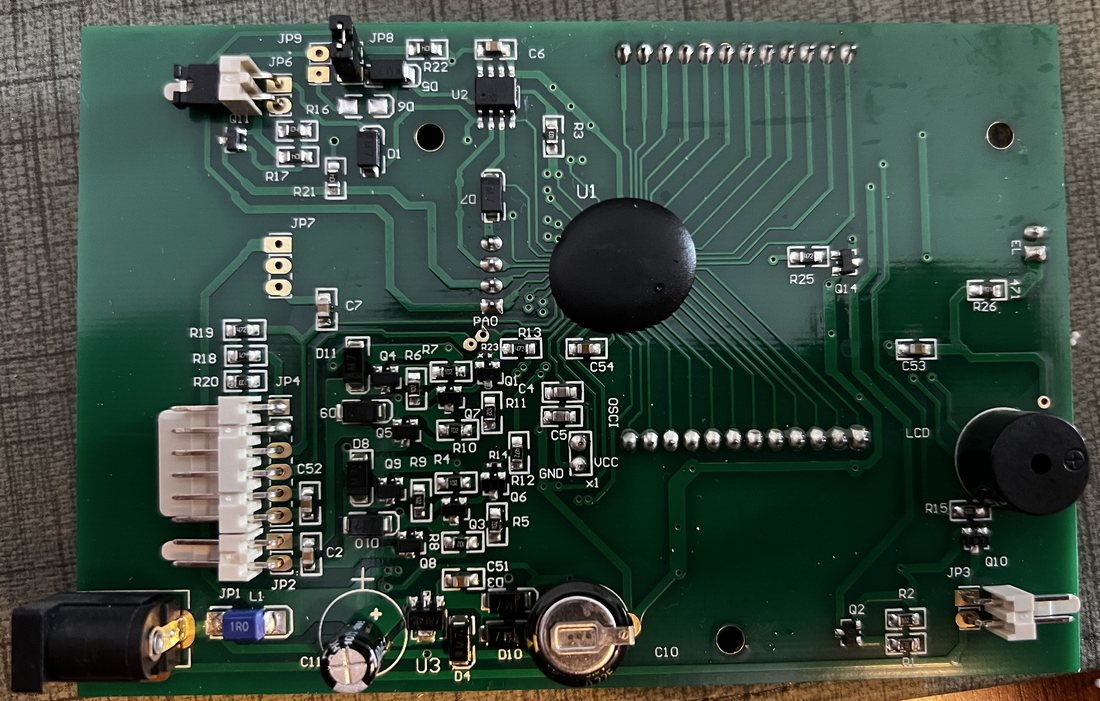
The owner's photo of the board. The power section is at the bottom left, and the processor is under the black blob.
What we found
On the bench at 12 V the board drew only about 10 mA. Nothing got hot and the display stayed blank. A low current like that can look like a dead board, but it doesn't prove one. A tiny regulator can use a few milliamps by itself, so power may well be getting in.
Next we measured the supply rails. The 12 V, 5 V and 3.3 V were all there, so the power section was doing its job. This is the fault that catches people out, because the obvious suspects all test good.
The scope then showed the real problem: no sign of the board running. There was nothing on the clock and no activity on the display lines. A flat clock doesn't prove much by itself, but with nothing else happening either, the processor looked like it wasn't starting.
Two small clues then pointed to one spot. A capacitor next to the processor, C54, measured 2.5 V where 3.3 V belonged, and there was a faint warmth in the same area.
The fix
We lifted C54 to check it, and the board came straight to life.
The capacitor itself measured fine at 1 µF. The problem was its solder joint, which had a high resistance and was costing the processor its proper supply. With the joint remade and the capacitor refitted, the same point read a clean 3.3 V and the display worked.
So a board that looked completely dead came down to one solder joint. No parts were needed, and the processor was fine all along.
We can't prove why the joint went bad, but humidity is the most likely cause. Water softeners tend to live in damp spots, and over time that can affect the joints on a board.
The result
The board now starts up with its display and backlight working. We ran it for about 20 minutes with no issues and power cycled it about 10 times. We also pressed around the repaired area while it was running, confirmed data flowing on the scope and checked the area stayed cool, then cleaned off the remaining flux. It shows a flashing 0:00 because the clock has reset, so the owner needs to set the time when it goes back in.
We can only test a board like this on the bench, not in the softener itself, and we say so before booking. The job came to the fixed £35 with nothing added for parts, and the repair carries our 90 day workmanship warranty.
Questions about this fault
Can a water softener control board be repaired? Often, yes. Many faults come down to standard parts or joints that can be repaired at component level. The exception is a failed processor. On a board like this one it sits under a black blob and can't be replaced.
Why would a water softener show no display if the power supply is fine? A working power supply only proves that power reaches the board. The fault can still be on the board, in the regulators that make its lower voltages or further on. On this one the supply rails were present, and a bad solder joint next to the processor stopped it running.
Can humidity cause a water softener board to fail? It can. We think that's what happened here, although a joint can't tell us for certain why it went bad. It's one reason a board with no visible damage can still have a fault.
Do I need to send the whole softener? No. Post just the control board. You don't need to send the plug-in power supply either, but tell us what its label says so we can run the board at the right voltage.
Will I need to set it up again afterwards? This one came back with its clock reset, so expect to at least set the time, and check your other settings while you're there.
Got a dead appliance board?
Our appliance board repair is £35 fixed plus any parts at cost, including the bench test and tracked return postage. Post just the board and we'll find out what has failed.