


Dead TV? Post us just the board
Nobody wants to courier a 55-inch TV, and you don’t have to. Almost every dead TV or monitor comes down to one board inside: the power supply. You unscrew it, post it to us in a shoebox, and we repair it at component level for £49 flat. If we can’t fix it, you don’t pay. Our step-by-step guide below shows you how to remove it safely.
Board repair pricing
Book with a £15 deposit, pay the balance only when the board is repaired. If we can’t repair it, you pay nothing beyond the £15 booking fee, which covers tracked UK return.
From our repair customers
Read the full customer reviews →“super professional and kept me informed”
Review excerpt · Google · September 2026
From the repair bench: See the Roland JP-8000 PCB repair and confirmed outcome.
In short: Hark Tech repairs TV and monitor boards by post from anywhere in the UK. You remove the board and post just the board, not the TV. Power supply and backlight driver boards are £49 flat, no fix no fee, tracked return included. Main boards and T-CON boards start with a £40 assessment, which counts towards the repair; most come to £80 to £120 in total. 90 days on the workmanship either way.
Faults that live on the power board
These are the classics. If yours is here, there’s a very good chance the board on the bench next week is yours.
Completely dead, no standby light
Nothing at all, not even the little red light. The power supply isn’t producing its standby rail, usually a blown fuse-diode chain or failed primary-side components.
Clicks, then nothing
A relay clicks once or twice, maybe the light blinks, then it gives up. The supply is trying to start, hitting a fault and shutting itself down to protect the TV. Very repairable.
Standby light, but won’t wake
The red light is on, the remote does nothing, or the light changes colour and nothing else happens. The standby rail works but the main rails never come up, classic failed capacitors.
Turns off randomly
Fine for ten minutes, then off. Or off the moment a bright scene loads. Tired capacitors sag under load and the protection circuit pulls the plug. Gets worse until it won’t start at all.
Backlight flickers or half-dark screen
Picture visible with a torch against the screen, flickering brightness, or one half of the screen darker than the other. That’s the backlight driver or inverter side of the board.
Monitor takes ages to turn on
Press the button, wait thirty seconds, picture eventually appears. The caps in the monitor’s power board have dried out and it takes that long to stagger up to voltage.
How to remove the board safely
Ten minutes with a screwdriver, but do it in the right order. PSU capacitors can hold a charge after the TV is unplugged.
The safe way, step by step
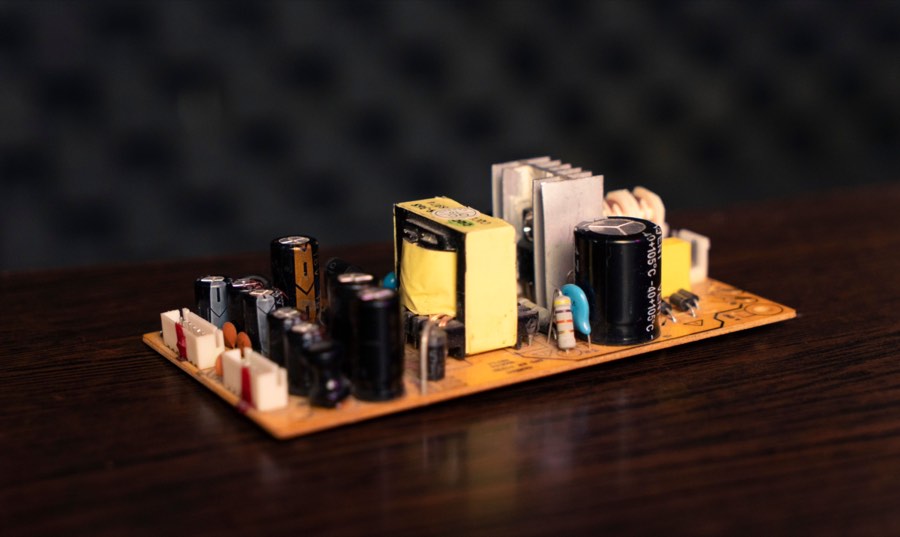
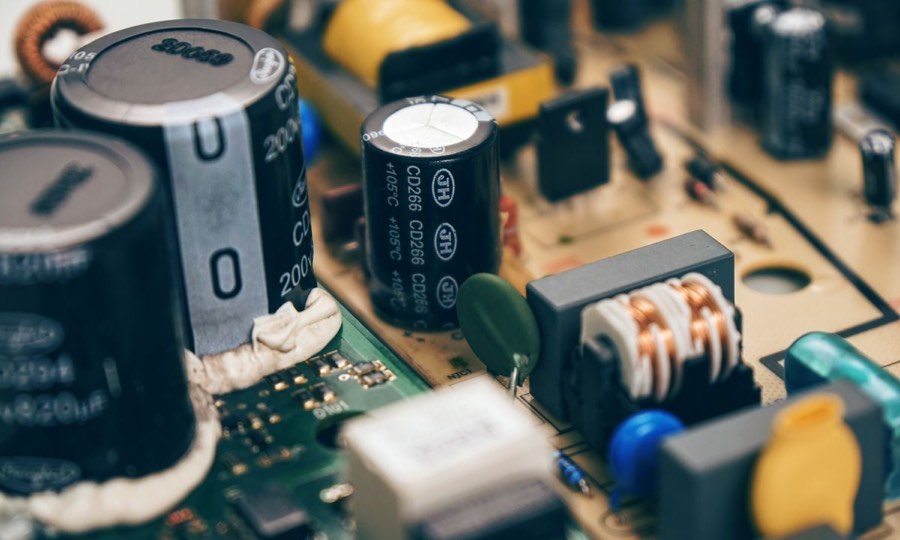
Lay the TV face-down on a blanket on a table and take the back panel off (it’s just screws around the edge). Inside you’ll usually see two or three boards: the power supply is the one where the mains lead arrives, with the big transformers and the row of cylindrical capacitors. It’s held in by a handful of screws, and every cable ends in a plug that simply unclips.
The one genuine hazard is stored charge: the large capacitors on the power board can stay charged for a while after unplugging, so give it the full 30 minutes and keep your fingers off the component legs and the underside of the board, handle it by the edges and it’s no more dangerous than any other circuit board. If anything in there doesn’t match what you expected, stop and send us photos, a free steer costs nothing and saves guesswork.
- Unplug the TV and wait 30 minutes before opening, the PSU capacitors hold charge
- Photograph every connector before unplugging it, reassembly becomes copy-the-photo
- Never touch the legs of the large capacitors or the board’s underside, hold it by the edges
- Note the model number printed on the board’s barcode sticker and include it when you book
One flat price, no fix no fee
Book with a £15 deposit. You post it to us, tracked return postage is in the price. Balance only when the board is repaired, before return post.
TV & monitor board repair
Power supply boards, monitor power boards, backlight driver / inverter boards and combined PSU + LED-driver boards.
£49
- Component-level fault-finding on the bench
- Failed caps, MOSFETs, fuses, diodes and joints replaced
- Quality Japanese capacitors: Rubycon, Panasonic, Nichicon
- Parts rated to or above the original specification
- Powered, load-tested and returned by tracked post (included)
- Can’t fix it? You pay nothing beyond the £15 deposit
- 90 days on the workmanship
What the £49 covers: TV power supply boards, monitor power boards, backlight driver and inverter boards, and combined PSU + LED-driver boards. Mainboards and T-CON boards are a different job, priced through a £40 assessment instead. See main board repair below.
If we can’t repair your board, you pay nothing beyond the £15 deposit, which covers the tracked return postage. The board comes back to you either way.
90% of dead boards share four faults
TV power supplies fail in predictable ways, which is exactly why a flat price is possible.
Failed electrolytic capacitors
The big one. Capacitors dry out and bulge with age and heat, and the rails they’re supposed to smooth start sagging. We fit quality Japanese replacements from Rubycon, Panasonic or Nichicon, rated to or above spec.
Dead MOSFETs
The switching transistors that do the hard work in a modern supply. When one shorts, the board is stone dead, often taking the fuse with it. Found with a meter, replaced with an equal or better-rated part.
Dried and cracked joints
Years of heating and cooling crack the solder around heavy components, transformers, connectors and heatsinked parts. Intermittent faults, clicks and random shutdowns live here. Reflowed properly, not bodged.
Blown fuse + diode chain
A surge or a shorted part downstream takes out the fuse, and usually a rectifier diode or two with it. Replacing just the fuse never works; we find and fix what blew it first.
Better than a used board
A secondhand replacement board is the same age as yours, with the same tired caps, often bought from a TV that died of something else. A component-level repair puts new parts in your board and comes with a warranty.
Backlight drivers too
Sound-but-no-picture TVs are usually the LED driver stage, either its own board or half of a combined board. Same bench process, same £49, same no fix no fee.
What the £49 includes
Component-level repair means finding and replacing the parts that failed, not swapping the whole board.
| Fault-finding | Board inspected and tested on the bench: fuses, rectifiers, MOSFETs, capacitors measured, joints checked under magnification |
| Capacitors | Failed and marginal electrolytics replaced with Rubycon, Panasonic or Nichicon parts, 105°C-rated, matched to or exceeding the original spec |
| Semiconductors | Shorted MOSFETs, diodes and regulators replaced with parts rated to or above the originals, never pulls from scrap boards |
| Joints & fuses | Cracked and dried joints reflowed, blown fuses replaced only after the cause is found and fixed |
| Testing | Board powered and every output rail measured under load before it’s declared repaired, not just “the fuse survived” |
| No fix, no fee | If it can’t be repaired you pay nothing beyond the £15 booking fee, which covers tracked UK return, and the board comes back to you |
| Return postage | Tracked return delivery included in the flat price |
90 days on the workmanship: if a part we fitted or a joint we made fails in normal use, we put it right free. Boards with heavy prior damage (burnt PCB, previous repair attempts) are photographed and quoted before any chargeable work.
From the back of your TV to our bench and back
Book online
£15 deposit secures your slot. We email the postal address straight away.
Post it in
Remove the board using the guide above, bag it, box it and send it tracked from any Post Office.
The repair
Fault found, failed parts replaced, every rail load-tested, typically 5–7 working days on the bench.
Back to you
Balance settled, posted back tracked. Refit it with your connector photos, 90 days on the workmanship.
TV main board repair, assessed first
Protection mode, a red standby light with no picture, or a TV that will not start even though the backlight comes on with the main board unplugged: those faults usually live on the main board. Main boards are repaired at component level too, but the fault has to be traced before it can be priced.
What the repair involves
The usual cause is a shorted component that stops the board starting up. We hunt it down on the bench and replace it when it is a standard, off-the-shelf part. If the short is in the memory or one of the main logic chips, those are very hard to source and replacing the board is the better option. We tell you straight away if that is what we find.
What the £40 covers
The £40 is the assessment itself. We test the board, trace the fault and tell you exactly what has failed and whether it can be repaired, even if the answer is that it cannot. If it is repairable you get a firm quote with the £40 already taken off, and nothing goes ahead without your OK. If it is not, the board comes back by tracked post with nothing further to pay.
Price and timing
Most main board repairs come to £80 to £120 in total, parts and tracked return included. Boards are usually diagnosed within 2 to 3 working days of arrival and returned within 5 to 10 working days. 90 days on the workmanship. Main board work is not no fix no fee.
Photos to send: the whole board top and underside, close-ups of anything scorched, bulging or cracked, the sticker with the board part number, and what the TV does when you switch it on.
Real example: a Sony KD-49XF9005 stuck in a boot loop, where testing showed the power board was healthy and pointed to the main board before any money went on the wrong part.
Other boards, other faults
Capacitor replacement & recap
Older kit with leaking or bulging caps throughout? Our recap service replaces every electrolytic on the board with quality Japanese parts, from £45.
Board & component soldering
Unknown faults or damage on any other board? Our PCB repair service covers SMD work, micro-soldering and BGA, with a £40 redeemable assessment. Just a loose wire or broken button? See small soldering jobs from £30.
3D-printed replacement parts
Snapped TV feet, broken brackets or a cracked rear panel clip? We reprint discontinued plastic parts in engineering materials.
Common questions
Why do I post the board and not the whole TV?
Because couriering a 55-inch TV is expensive, risky and usually not insured for the panel, one knock in transit and the screen is worthless. The power supply board is a flat piece of electronics about the size of a paperback book that posts safely for a few pounds. Almost every dead-TV fault we see lives on that board, so posting just the board gets the same repair with none of the courier risk. Our safe-removal guide above walks you through getting it out, and if you’re in any doubt, send photos first for a free steer.
How do I know which board is faulty?
The symptoms map to the boards fairly reliably. Completely dead with no standby light: power supply board. Standby light on but the TV won’t wake: usually the power supply, occasionally the mainboard. Sound but no picture, or a picture you can only see with a torch shone at the screen: backlight driver or inverter. Half the screen dark: backlight driver. If you’re not sure, photograph the boards inside the TV along with the model number and send them over, photo diagnosis is free and we’ll tell you which board to post.
What happens if the board can’t be repaired?
No fix, no fee. If we can’t repair your board you pay nothing beyond the £15 deposit, which covers the tracked return postage, and the board comes back to you so you still have every option open. We’ll also tell you honestly what we found, which usually helps you decide between a replacement board and a new TV.
Why not just buy a used replacement board online?
You can, and sometimes that’s the right call, but a secondhand board is the same age as yours with the same tired capacitors, so you’re often buying the same failure a year or two early. A component-level repair replaces the actual failed parts with new, better-rated ones: quality Japanese capacitors from Rubycon, Panasonic or Nichicon, and semiconductors rated to or above the original specification. The repaired board is in better health than a used spare, and it’s guaranteed for 90 days.
How long does the repair take?
Typically 5–7 working days on the bench from arrival to return dispatch, plus tracked postage each way. The postal address is emailed as soon as you book. If the board needs a part we have to order, we tell you straight away with a revised date.
Is there a warranty?
90 days on the workmanship. If a part we fitted or a joint we made fails in normal use, we put it right free. The warranty covers our repair work on the board, it can’t cover unrelated components on a board that’s already many years old.
Can you repair monitor boards, bench PSUs or other power boards?
Monitor power boards and combined PSU + LED-driver boards are covered by the same £49 flat price. Bench power supplies, amplifier supplies, arcade PSUs and other power electronics are usually repairable too, send photos through the contact page and we’ll confirm before you book. Mainboards and T-CON boards are a different kind of fault-finding, so for those we ask for photos first and then use the £40 board assessment rather than the £49 flat price.
How should I pack a bare board for posting?
Anti-static bag first if you have one, a clean plastic bag is a reasonable substitute, then a generous wrap of bubble wrap, then a box with padding on all sides so the board can’t shift. Don’t let bare bubble wrap press directly onto the pins on the underside without a bag between them. We email you the postal address as soon as you book, so all you need is a box and a tracked postage service.
Can you repair a TV main board?
Yes, at component level by post. Main boards and T-CON boards go through a £40 board assessment rather than the £49 flat price, because the fault has to be traced on the bench first. The usual cause is a shorted component, which we hunt down and replace when it is a standard, off-the-shelf part. If the short is in the memory or one of the main logic chips, those are very hard to source and replacing the board is the better option, and we tell you straight away. Most main board repairs come to £80 to £120 in total including parts and tracked return, the £40 counts in full towards that, and you get a firm quote before any chargeable work.
My TV has a red standby light but no picture, or goes into protection mode. Which board is it?
If the backlight comes on when the main board is unplugged, the power supply and LED strips are working and the fault is usually on the main board. A completely dead TV with no standby light is usually the power supply board. Send photos of both boards and the model number and we will tell you which one to post.
What does the £40 main board assessment cover?
It is the assessment itself: we test the board, trace the fault and tell you exactly what has failed and whether it can be repaired, even if the answer is that it cannot. If it is repairable you get a firm quote with the £40 already taken off and nothing goes ahead without your OK. If it is not, the board comes back to you by tracked post with nothing further to pay. Main board work is not no fix no fee.
Which TV brands do you repair boards for?
Brand does not matter much at component level. Samsung, LG, Sony, Philips, Panasonic, Hisense, TCL and other TVs use the same kinds of capacitors, MOSFETs, regulators and connectors. Send the model number and board part number from the sticker with your photos and we will confirm before you book.
Don’t skip the TV, post the board
£49 flat, quality Japanese capacitors, no fix no fee and 90 days on the workmanship. Serving the whole UK by post from Basingstoke, one shoebox at a time.